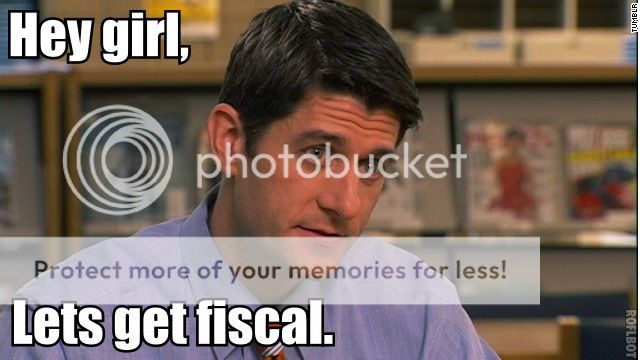
The Democrats engaged in a great deal of demagoguery during the 2012 campaign regarding Paul Ryan's dedication to fixing our Social Security and Medicare systems so that they can avoid total collapse in the decades to come. They utilized the standard scare tactics (throwing granny off a cliff) as well as accusing Ryan of being "stupid" and a "liar." The one thing they did not do - because they could not do - was offer any kind of solution of their own. Obama and Reid didn't even bother kicking the can down the road. They simply ignored the can altogether and counted on the ignorance of Democrat voters to see them through to election day.
Well, the strategy succeeded but it was surely a hollow victory since the iceberg is still lurking out there in the future.
A central factor in the looming financial crunch is the fact that our
society is aging. The “Baby Boom” generation has already started to
collect their Social Security retirement benefits. As a result, there
are fewer workers to support each retiree than when Social Security was
created. Increasing life expectancy and the approaching retirement of
more Baby Boomers continues to put increasing pressure on Social
Security each year. Over the next several years, the number of retirees
is expected to grow more rapidly than the number of individuals whose
taxes will pay for future benefits. Because of this, the number of
workers supporting each Social Security recipient is projected to fall.
According to the 2012 Social Security Trustees Report, beneficiaries
will face a painful 25 percent benefit cut in 2033 when the Trust Funds
are exhausted – three years sooner than projected just last year. At
that time, even those who are currently on Social Security – those now
62 and older – may experience indiscriminate cuts in benefits at a time
when they are increasingly reliant on the program.
Luckily, we still have Paul Ryan working hard in the House of Representatives on behalf of the American people.
"If we want millionaires to pay more taxes, then we need an economy where
there are more millionaires."
As Conservatives already understand, our federal government does not really have a revenue problem. What it does have is a spending problem. The runaway spending is a serious problem for our nation. It must be dealt with ASAP. But if you want greater revenue then raising taxes is not the solution. Democrats are functionally illiterate when it comes to economics. They must have it explained to them, so... As Stephen Moore explains:
Let's start with the 1920s. All tax rates were cut during the Calvin
Coolidge administration, including the top rate, which fell to 25% from
the World War I high of 73%. Between 1923 and 1928, benefited by lower
tax rates, the economy surged, raising incomes and living standards for
the middle class. Tax collections in real terms nearly doubled—and the
share of taxes paid by those who made more than $100,000 a year (more
than $1 million today) increased to 51% from 28%.
The top tax rate rose to 63% in 1932,
to 79% in 1936, and to 90% during World War II. The higher rates
persisted after the war, and while the economy grew as the government's
economic role ebbed, high rates generally helped to hold back the pace
of growth.
Tax rates weren't reduced much until the Kennedy administration. JFK
cut rates by about 30% for every income group. He argued that the lower
tax rates would "boost the economy, produce revenues, and achieve a
future budget surplus." He even called lower rates "an investment in the
future."
The Kennedy tax cut was enacted in 1964 (after JFK's assassination),
lowering the highest tax rate to 70% from 91%. His prediction that the
economy would surge was validated by rapid growth every year from 1965
through 1968. Tax collections grew by 8.6% per year and unemployment
fell to 3.4%. "The unusual budget spectacle of sharply rising revenues
following the biggest tax cut in history," announced a 1966 U.S. News
and World Report article, "is beginning to astonish even those who
pushed hardest for tax cuts in the first place."
Americans earning over $50,000 per year
(the equivalent of about $250,000 today) increased their tax payments
by nearly 40% after the rate cut, according to a report from the Joint
Economic Committee of Congress. Their share of overall taxes paid rose
to almost 15% in 1966 from 12% in 1963. Americans with an income of more
than $1 million nearly doubled their tax payments to $603 million in
1965 from $311 million in 1962.
As Obama is fond of saying: Let's have that discussion...
If you raise taxes does it automatically follow that you'll raise more
revenue? Is there a point at which tax rates become counterproductive?
UCLA Economics professor Tim Groseclose answers these questions and
poses some fascinating new ones.
Jenny is a 13-year-old 8th grader who's been interested in politics for a
couple of years. She was confused about the claims of the Democrats
and the claims of the Republicans. So, she decided to look at the facts
and do a report card for President Barack Obama and one for Governor
Mitt Romney. She compared them and now presents her findings in this
video.
This election year is vital to the future of the country we love so much. It has now become a campaign of ideas and visions (at least for Republicans) and Mitt's tapping of Paul Ryan as his VP draws a line in the sand. This is just a taste of what is to come! Well played, sir!